Home > Success stories > Advancing Agricultural Transformation in Ethiopia through Mechanization Financing: The AMLP Experience
Advancing Agricultural Transformation in Ethiopia through Mechanization Financing: The AMLP Experience
Introduction
The Agricultural Mechanization Leasing Project (AMLP I) was implemented to expand access to modern agricultural machinery in Ethiopia through a leasing model. The project aimed to improve agricultural productivity, support job creation, and strengthen institutional capacity within the Development Bank of Ethiopia (DBE). The project was implemented between 2018 and 2024, with monitoring and evaluation continuing into 2025.
Financial Overview
KfW on behalf of the German Government provided EUR 13 million to finance agricultural machinery and related capacity-building activities. More than EUR 10 million of this financing supported the procurement of modern agricultural equipment manufactured in Europe.
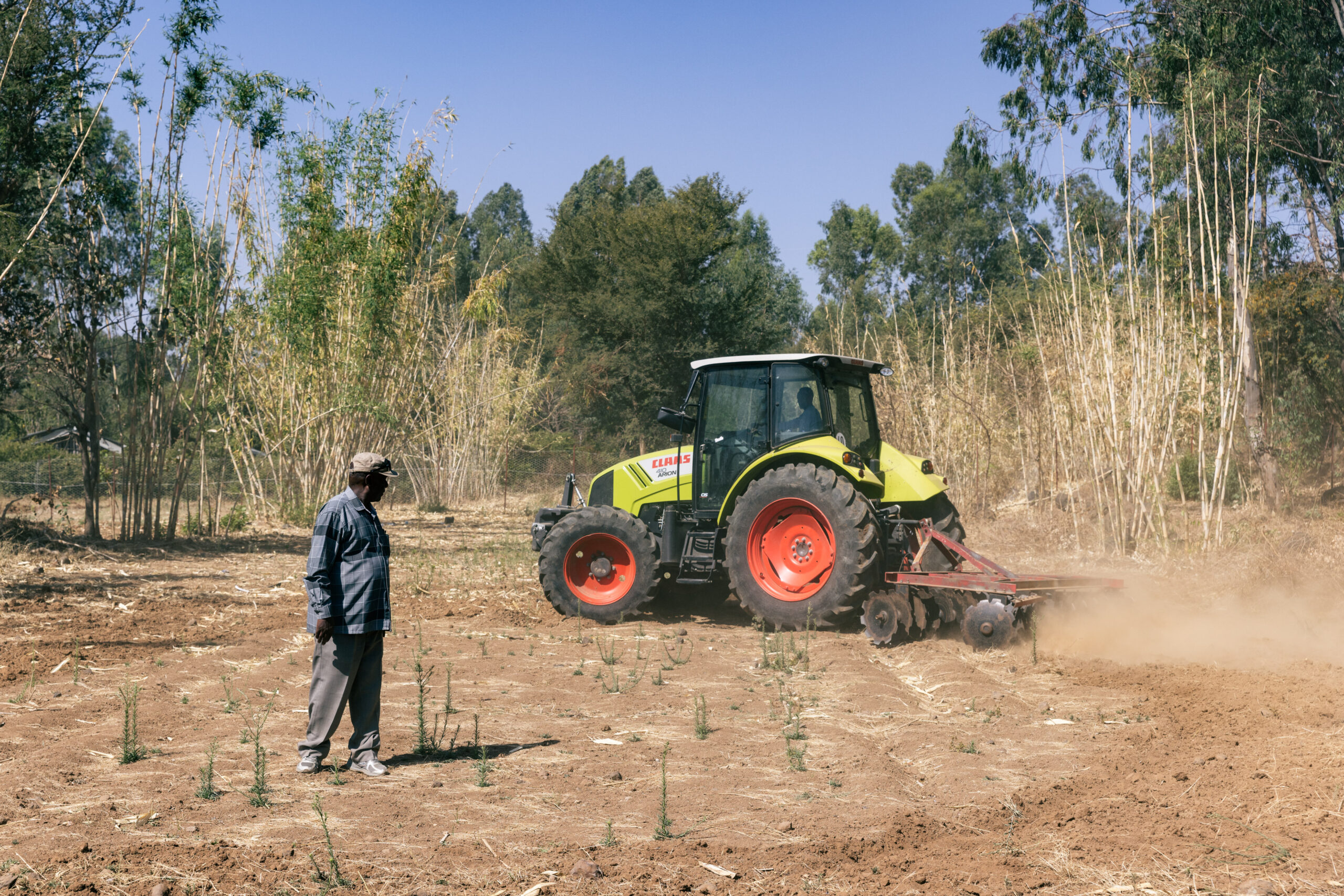
Through these funds, the project financed approximately 205 pieces of agricultural equipment, including tractors, combine harvesters, and related implements.
The project generated measurable impacts on agricultural productivity and employment. Modern machinery financed through AMLP I enabled significant increases in mechanized agricultural operations. Combiners supported harvesting activities across approximately 23,600 to 59,000 hectares annually, while tractors and related equipment facilitated ploughing and discing on approximately 10,000 to 12,000 hectares each year.
In terms of employment, the project contributed to the creation of new jobs across the agricultural value chain. The Project contributed an estimated 340–510 indirect jobs, and 1,500–1,700 new direct jobs.
The project also contributed to broader livelihood improvements. Round 10,000–30,000 people experienced improved livelihoods through combiner-related services, while an additional 5,000–6,000 people benefited from the increased use of tractors and associated implements.
Institutional Capacity Development
A key component of AMLP was institutional strengthening. The project provided extensive training and knowledge transfer to the Development Bank of Ethiopia (DBE). In total, 589 DBE staff members participated in 20 different training sessions focused on leasing operations, agricultural finance, and machinery management.
Operationally, the project engaged 19 DBE branches and district offices across five regions, strengthening decentralized implementation and enhancing the bank’s ability to manage agricultural leasing programs.
The AMLP I project followed a multi‑year implementation structure. A feasibility study was conducted in 2018, followed by contract finalization and project launch in 2019–2020. Disbursements were implemented in phases, with three major tranches of €3.25 million, €6.5 million, and €3.25 million. Alongside financial implementation, monitoring and evaluation activities and exposure visits were conducted. The project was formally closed in 2025 following completion of implementation and impact assessment.
Conclusion
Overall, AMLP successfully demonstrated the potential of leasing-based agricultural mechanization financing in Ethiopia. The project significantly increased access to modern machinery, improved agricultural productivity, supported job creation, and strengthened institutional capacity within the Development Bank of Ethiopia and related sector stakeholders. The results highlight the value of mechanization financing programs as a tool to accelerate agricultural transformation and rural economic development in Ethiopia.