Success Story and Good Practice on KOICA-funded Capacity Development of TVET Leaders and Trainers Ethiopia Project
In 2020, KOICA entered into a Record of Discussion (Project Funding Agreement) with the Federal Democratic Republic of Ethiopia (FDRE) Ministry of Labor and Skills (MoLS), previously known as the Ministry of Science and Higher Education (MoSHE), to commence the implementation of the “Capacity Development of TVET Leaders and Trainers in Ethiopia Project.” The project aimed to develop human resources and strengthen technical capacity to support Ethiopia’s transition to a lower-middle-income country and promote balanced economic development by 2025. A total budget of USD 8.4 million (USD 8,400,000) was allocated by the Korea International Cooperation Agency (KOICA) for the project implementation period from 2020 to 2025.
The project focused on strengthening the capacity of TVET leaders and trainers in Ethiopia through six major components: (i) capacity-building programs, (ii) curriculum redesign, (iii) textbook development, (iv) equipment provision for six TVTI departments, (v) academy-industry cooperation, and (vi) the establishment of an e-learning content development system.
Despite disruptions caused by the COVID-19 pandemic, the project successfully adapted its implementation approach and completed all planned activities in 2025. The project made significant contributions to improving the quality, relevance, and sustainability of Ethiopia’s TVET system by enhancing institutional capacity, modernizing teaching and learning resources, strengthening industry partnerships, and promoting digital transformation in education.
The project generated several important benefits, including enhanced leadership and managerial capacity of TVET institutions, modernized curricula aligned with industry requirements, improved teaching and learning quality, expanded access to modern training facilities, strengthened academy-industry collaboration, upgraded technical and pedagogical competencies of trainers and lecturers, increased graduate employability, and the establishment of a sustainable foundation for long-term TVET development.
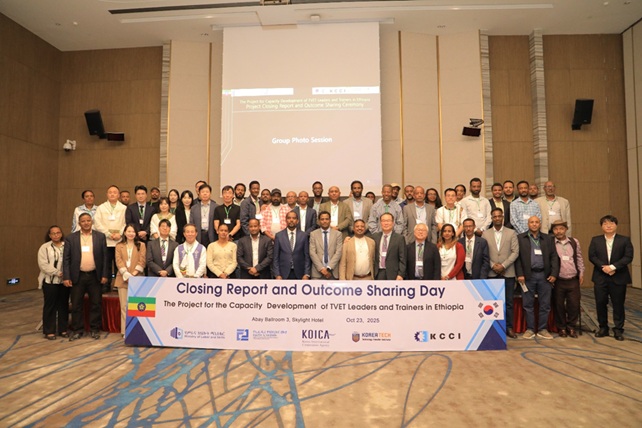
Photo: TVET leaders, trainers, and officials participate in a KOICA-supported capacity-building workshop, strengthening leadership, technical expertise, and institutional performance across Ethiopia’s TVET system.
Notable Outcomes
- Capacity-building programs delivered to 259 TVET leaders, managers, officers, lecturers, and trainers
- Six departmental curricula redesigned and practice-oriented handbooks developed to improve the relevance and quality of TVET education.
- A total of 113 textbooks developed.
- Six departments equipped with furniture and 330 types (2,615 units) of modern practical training equipment
- Academy-industry collaboration strengthened through 32 industry partnership agreements (MOUs) and the development of seven industry-academia cooperation manuals.
- One E-learning Content Development Center established and eight digital learning contents developed
Lessons Learned
- Effective coordination among stakeholders, the implementing partner, and the Project Management Consultant (PMC) substantially enhanced project implementation and outcomes.
- The provision of high-quality, technologically advanced equipment significantly improved the quality of education, training, and institutional functionality.
- The development of new textbooks and redesigned curricula enhanced the quality and relevance of TVET education.
- KOICA’s direct technical assistance approach demonstrated an effective model for development cooperation.
“The KOICA-supported project has brought transformative changes to the Federal TVET Institute, its Information Technology Department, and the Ethiopian TVET sector as a whole. Its major contributions include the provision of modern training equipment and educational technologies, which significantly enhanced the quality of practical training and improved the learning environment. The project introduced a new curriculum development approach focused on competency-based, industry-responsive, and practice-oriented training; instead of creating entirely new programs, it redesigned existing curricula to strengthen practical learning, better align with labor market needs, and establish a more systematic and standardized curriculum development format, thereby greatly improving the relevance and effectiveness of TVET training delivery both within the institute and across the sector. Another key achievement was the development of textbooks based on the redesigned curricula, with lecturers actively participating in writing teams and gaining valuable experience in curriculum interpretation, instructional design, educational content development, and academic writing; these textbooks have become vital resources supporting quality and consistency in training. Additionally, the project implemented extensive capacity-building programs for instructors, TVET leaders, managers, curriculum experts, and industry representatives, strengthening technical expertise, pedagogical competence, leadership capacity, and industry collaboration. It also supported the development of e-learning content and digital learning systems to enable technology-enhanced learning. As a direct witness to the project’s implementation and outcomes, its impact has been substantial and sustainable, making significant contributions to institutional strengthening, human resource development, and the overall modernization of the Ethiopian TVET sector.” Mr. Miskir Solomon Tsige, Head, Information Technology Department, Federal Technical and Vocational Training Institute (FTVTI)
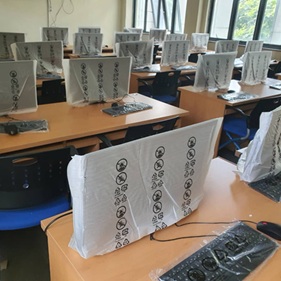
Photo: A modern computer lab at the E-learning Content Development Center, showcasing digital infrastructure established to support technology-enhanced learning and the development of online training content.
“The Department of Building Construction Technology at the Federal TVET Institute proudly confirms the successful implementation and transformative impact of the KOICA Ethiopia-supported project. The project has produced sustainable and far-reaching benefits for both the institution and the wider construction sector. KOICA Ethiopia facilitated the development of 22 textbooks, delivered multiple rounds of technical and pedagogical training for academic staff, enhanced equipment operation and maintenance capacities, and supported the creation of e-learning modules for core courses. These interventions have fundamentally upgraded the quality of education, strengthened the competence of trainers, and improved the department’s ability to produce skilled professionals for Ethiopia’s construction industry. The Department highly values KOICA Ethiopia’s invaluable contribution and considers this partnership a successful model of international cooperation that has created lasting institutional change.” Mr. Solomon Getahun, Department of Building Construction Technology, Faculty of Civil Technology, Federal TVET Institute

Photo: Sewing machines provided to the Garment Department demonstrate upgraded practical training equipment, enhancing hands-on learning and equipping trainees with industry-relevant skills.
Challenges
During the project implementation period, the global COVID-19 pandemic caused unavoidable disruptions to invitational trainings and capacity-building activities. In response, the project shifted to online learning by developing an online training platform and establishing e-learning studios to ensure continuity of learning. In addition, 24 types and 868 units of quarantine materials and equipment were supplied. Although the pandemic extended the project period from 2020–2025 to 2020–2026, all planned project activities were successfully completed in 2025.
Recommendations
- Ensure sustainability and scale up successful practices: Institutionalize project outcomes and disseminate successful models to regional governments and other development partners for wider replication.
- Deepen practical industry integration: Further strengthen industry participation in the design and delivery of training programs to better align TVET education with labor market demands.
***
Source: This story is authored by KOICA Ethiopia